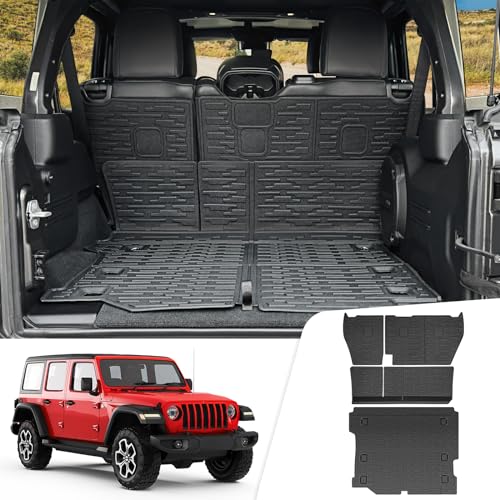
Jeep JL 4-Door Cargo Liner + Seat Back Protector
Check price on Amazon
Buy →Pull the doors and your seat fabric is a direct target for UV, rain, blown trail grit, and anything that comes in sideways. Most seat covers weren't built for that. Here's what to look for, what fails first, and what holds up when you're running doors-off all summer.
Seat covers are easy to skip when the Jeep still looks clean. Three months of doors-off summer later you pull a cover back and find faded, gritty factory fabric underneath. The problem is usually material and fit: the wrong cover migrates, soaks through, or bakes in the sun and starts cracking by August. This guide covers what actually survives.
A seat cover in a closed car mostly deals with wear from people sitting in it. Pull the doors on a Wrangler or Gladiator and that same cover is now handling direct sun from every angle, rain that hits it sideways instead of trickling through a cracked window, and trail grit traveling horizontally into the cabin at speed.
Two specific failures show up fast. UV degradation happens without any door glass or A-pillar shade to filter it; dyed fabric that holds its color for years in a closed car fades in one summer of direct exposure. Fit failure happens because the door panel braces the outer seat bolster on both sides. Remove the door and that outer edge is unsupported, which is where loosely fitted covers migrate first, especially with the body movement of trail driving.
Water is a third problem. Rain on a closed-window car mostly comes from above. Doors-off rain hits the seat from the side at whatever angle the sky is throwing it, which means covers that merely shed top-down water let rain wick straight through the outer seam.
Most seat cover listings lead with looks. For a doors-off Jeep, four performance specs matter more:
Three materials dominate the serious seat cover market for off-road use, and they each make a different tradeoff.
Neoprene is the default recommendation for daily drivers running doors-off through summer. It's inherently water-resistant, UV-stable, flexible enough to fit contoured seats without pulling at the bolsters, and it wipes clean and dries fast. The downsides are heat retention in direct sun and the fact that cheaper neoprene uses a thin foam core that compresses and loses shape after a season. Some covers also have a tendency to abrade at the outer bolster edges when you're sliding in with sandy clothing regularly. Good quality, model-specific neoprene covers hold up well across that tradeoff.
Canvas and ballistic fabric (600D to 1000D polyester weaves) are heavier and more abrasion-resistant. A 1000D canvas cover takes more punishment than neoprene on repeated trail days. The tradeoff: most canvas covers are not waterproof unless coated, and a coated canvas cover adds weight and reduces breathability. They're also stiffer to fit and remove. For a Gladiator or JK that lives on trails rather than streets, canvas or a ballistic-weave cover holds up better long-term at the areas that see the most abrasion.
Universal polyester and nylon blends are the budget tier. They can work for a single season, but thinner materials fade faster under continuous UV and the anchor hardware is usually lighter duty. Fine for occasional doors-off days; not the move for a Jeep running doorless from April through October.
Some covers use a combination: neoprene on the high-wear cushion surfaces with a canvas or 600D panel on the sides and back. That's a reasonable tradeoff for mixed street-and-trail use if you can find it in a model-specific fit.
A universal cover fits any seat. A custom-fit cover is cut for a specific Jeep model and year. The gap in quality between them matters more for doors-off use than it does for a standard commuter car.
Universal covers use a generic pattern and adjust via straps and elastic. On most Jeep seats, this leaves slack in the bolster area and around the headrest attachment point. That slack is where migration starts. One trail run with side-to-side body movement and a loose universal cover is already sliding toward the transmission tunnel. If you go universal, prioritize covers with the most anchor points: under-seat straps at both front corners, rear clips that wrap under the seat base, and a tight headrest loop that doesn't depend on the door-side bolster to hold position.
Custom-fit covers are cut for JL, JK, or JT seat geometry. JL Wrangler seats differ from JK seats in bolster shape and headrest post diameter. JT Gladiator seats share broad architecture with the JL but have minor differences in rear bench and front seat mounting. A cover built for your exact model sits flat, doesn't pull, and stays anchored where it's supposed to. For seats spending all summer in direct sun and rain, custom fit is worth the price difference.
One thing to watch: some sellers list a cover as "fits JL/JK/JT" when it's really a universal pattern with adjustable straps. Check whether the listing gives specific seat measurements or model-year callouts. A real custom-fit cover will name the year range and note which trim's seat it fits.
Seat cover sets come in two configurations: front-seat-only (or rear-bench-only), or full sets covering front buckets plus the rear bench.
For doors-off use, the front buckets take the most punishment. Driver and passenger seats are at the widest open point of the cabin and get the most direct sun and lateral water exposure. Front-only coverage is the minimum worth doing.
Rear bench coverage still makes sense if you regularly carry passengers or gear back there. The rear seat fabric on a JL or JT is the same factory material as the fronts and degrades at the same rate under sun and grit. A full set costs more upfront but you get consistent coverage and a matching fabric across both rows.
For JK owners: the JK has a split rear bench that folds differently from the JL's. Full sets sized for JL rear benches often don't fit JK fold points correctly. Check fitment specifically for JK if you're buying a full set.
A seat cover handles the seat cushions. These cover the cargo floor, seat backs, and center console: the rest of the interior a doors-off run can trash.


A seat cover protects the cushion surfaces. The rest of the interior still takes hits when you're running doors-off, and a few additions cover the rest of the problem.
A cargo liner handles the rear floor, which collects trail mud, wet boots, and sand at a rate that surprises most people on their first wet trail day. The UTIIY liner for the JL 4-door includes rear seat back protectors as part of the set: the panels behind the front bucket seatbacks that rear passengers and gear press against. Most seat cover sets don't include those panels, so the cargo liner plus seat back mat combination fills the gap a front-seat cover leaves.
A center console organizer keeps the loose items that multiply when you don't have door pockets. Without door map pockets, everything migrates to the center console area or the floor. On a doors-off run where the cabin is fully open, any loose item on the seat or floor can become a projectile on a trail obstacle.
Rear wheel well storage bins on the JL 4-door mount in the rear wheel arches and turn dead space into fixed storage, which keeps recovery gear and trail tools off the seat surface entirely. Less gear on the seat means less abrasion on the cover and less migration from weight shifting on trail.
For a daily driver that goes doors-off on weekends: neoprene, custom-fit, full front and rear coverage. That combination handles the street-to-trail transition without requiring cover swaps. Neoprene wipes clean, dries fast, and holds its shape through a full season.
For a dedicated trail rig: canvas or high-denier ballistic fabric outperforms neoprene on abrasion. If the Jeep sees mud, sand, and rocky trails regularly, thicker fabric takes more punishment at the bolster edges where damage accumulates fastest. Pair it with a coated or waterproof backer if rain is in the picture; straight canvas that isn't coated soaks through.
For a JK: buy JK-specific covers. The 2007-2018 seat shape, bolster geometry, and headrest post diameter differ from the JL (2018-present) enough that JL covers won't fit correctly, particularly around the headrest posts and the rear bench fold points. Most quality brands carry separate JK and JL/JT variants; look for the JK callout in the product title or description.
Whatever you buy, get from a brand that names the specific model and year the cover fits. A listing that says "fits most Jeep Wranglers" is a universal fit in disguise. The extra cost for a confirmed model-year fit is what keeps the cover on the seat rather than crumpled against the center console by mile ten of a trail run.
General guidance for Jeep Wrangler and Gladiator owners. Seat cover compatibility varies by model year and manufacturer. Confirm fitment for your specific model and year before purchasing.
A seat cover is the cheapest protection against three months of doors-off sun and rain. Pick the right material and fit and you'll pull it back in October to find clean, intact factory fabric underneath.