Doors stay home.
Hang them like you mean it.
You spent ten minutes pulling the doors off. You'll spend the next six months forgetting they exist. That gap between take-off and reinstall is where most door damage happens, and all of it is preventable.
A foam hanger, a tube of seal conditioner, and a labeled hardware bag run about thirty dollars total and take thirty minutes once a year. The alternative is scratched paint, a hinge pin that won't move, and a seal that crumbles when you try to reinstall in October.
The lean-against-the-wall problem
Most Jeep doors spend their off-season doing one of three things: leaning against a painted wall, sitting on a concrete floor, or stacked on top of each other with a moving blanket in between if the owner was thoughtful about it. None of those is good storage. Here is what actually goes wrong:
- Paint scratches and pressure marks. A door leaning against a wall rocks slightly every time someone walks past, and that micro-movement grinds grit between the door panel and whatever it's resting on. By spring you have scuffs. On concrete, the door's weight concentrates on the lower edge and the corner and the paint transfers or chips.
- Rubber seals harden and crack. The door weatherstripping and window seals are rubber, and rubber that sits in a dry garage without any conditioning compound slowly loses its plasticizers. A seal that was pliable in May can be brittle by October, and once it cracks the door won't seal properly after reinstall.
- Hinge pins stiffen up. The hinge pins that stayed exposed all season collected road grime and moisture. Left unlubricated in storage, that film dries into a paste that makes the pins stiff, and stiff pins put extra load on the hinge during reinstall — which is how people strip hinge bolts they have pulled cleanly for years.
- Interior panels fade and chalk. An interior door panel stored in direct sunlight (through a garage window or door) gets the same UV exposure it would get on the trail, without the driver noticing. By the time you reinstall, the panel has a chalky oxidized look that's a lot harder to reverse than it was to prevent.
Before you hang them: the pre-storage cleanup
Ten minutes of prep before the doors go up pays back every season. Do this before storage, not after — cleaning after six months means reversing damage instead of preventing it.
- Wash the exterior panels. Road film, trail dust, and any salt from late-season runs should come off before storage. Soap, water, rinse, and let them dry completely before the next step.
- Clean and dry the hinge cavities. The two T-40 hinge bolt holes on each door trap grit and moisture. Flush them with clean water, then dry with a rag or a blast of compressed air. This is the step most people skip and the one that causes the most grief in spring.
- Lubricate the hinge pins. A dry-film PTFE or dry silicone lubricant on the hinge pin faces keeps them from stiffening in storage. Skip WD-40 here; it is a moisture displacer, not a lasting lubricant, and it gums up as it dries. A dry-film product stays slick through a whole off-season.
- Condition the rubber seals. Apply a silicone-based rubber conditioner to the weatherstripping around the door perimeter and the window seal if your door has a full window. Work it in with a rag, let it soak for a few minutes, wipe off the excess. This is the one product that most directly extends seal life.
- Apply UV protectant to interior panels. Spray or wipe a dry-touch UV protectant on the interior door panel, especially if storage is anywhere with sun exposure. Matte or dry-touch formulas are the right call; high-gloss silicone dressings attract dust and turn greasy.
How to hang them: foam hangers, wall mounts, and DIY
The goal is simple: no bare paint resting against any hard surface, no weight concentrated on the lower edge or corners, and the door hanging from its structural hinge side rather than propped from the glass side.
There are three real options:
- Foam door hanger kits. These are the dedicated solution. A foam-lined hook drops over the top edge of the door on the hinge side; the door hangs from a wall stud mount or ceiling joist. The foam protects the paint at every contact point. They are sold as two-door or four-door kits and are available on Amazon under fifty dollars. For most JL/JT owners, this is the right answer.
- Wall-mount door brackets. A step up from hangers: dedicated wall brackets with padded saddles that hold each door in a fixed vertical position. More installation work (you are mounting hardware to studs), but the door is more stable. JK owners benefit especially because the JK door is heavier than the JL.
- DIY with pool noodles. If you have exactly one season to get through and do not want to spend money: a pool noodle sliced lengthwise and slipped over the top edge of the door, with the bottom edge resting on another noodle, does work. It is not as stable as a hanger kit and requires more attention to positioning, but it beats bare paint on concrete.
A few details that matter regardless of which method you pick:
- Hang from the hinge side, not the latch side. The hinge side is the structural edge; the latch side has more fragile alignment hardware.
- Keep doors off concrete floors. Concrete wicks moisture and the contact point concentrates the door's weight on a painted edge.
- Leave space between doors if storing multiple. Even with blankets between them, vibration from a garage door or HVAC can cause them to rub over months.
- Climate-controlled storage is better, but an unheated garage works fine if the doors are prepped correctly. Moisture plus grit is the problem, not cold alone.
Seal and panel care through the off-season
The silicone conditioner you applied before hanging is not a one-time treatment if the doors sit for more than three months. For a short off-season, one application is fine. For a full winter, a mid-storage re-application keeps the rubber from hardening during the cold, dry months.
For window glass: if your doors have full glass (JK full doors or aftermarket), wipe them clean before storage. Glass stored dirty with road film gets a light etch from dried mineral residue sitting against it for months. A clean wipe before storage removes the variable.
If the storage space gets sun at any point during the day, orient the interior panel side away from the light source. The exterior panels are painted with UV-stabilized clearcoat; the interior panels are bare plastic that fades faster.
Hardware: the step that saves forty-five minutes
Every set of Jeep door hardware (the T-40 hinge bolts and any retaining hardware) should be in a labeled bag attached to that specific door before it goes into storage. Not in a drawer. Not on a shelf. Physically with the door.
The reason is mixing. Hinge bolts are not fully interchangeable across doors, and the thread engagement specs differ between JK, JL, and JT. A bolt from the front-right hinge reinstalled into the rear-left creates a cross-threading risk and changes the torque feel at spec. One labeled bag per door (FRONT LEFT, FRONT RIGHT, REAR LEFT, REAR RIGHT) takes a minute to set up and means reinstall day in spring takes five minutes instead of forty-five.
Tape or zip-tie the bag to the door's interior grab handle or mirror hole. It will be there when you need it, and you will know immediately if a bag is missing before you start reinstalling at 7 AM in October.
The option that eliminates the problem
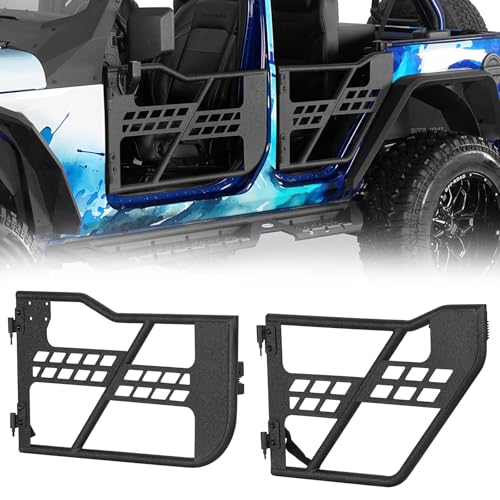
Tube half-doors stay mounted to the Jeep. There is nothing to hang, nothing to condition, nothing to store. The hinge bolt rotation that wears out hinge pockets never happens. The weatherstripping you would otherwise be conditioning every fall belongs to a door that never came off.
The tradeoff is real: tube doors give you less weather sealing than a full door and no window glass, which matters in cold climates or if you drive through rain regularly. But for owners who run doors-off from April through October and live in a dry climate, tube doors change the seasonal math entirely.
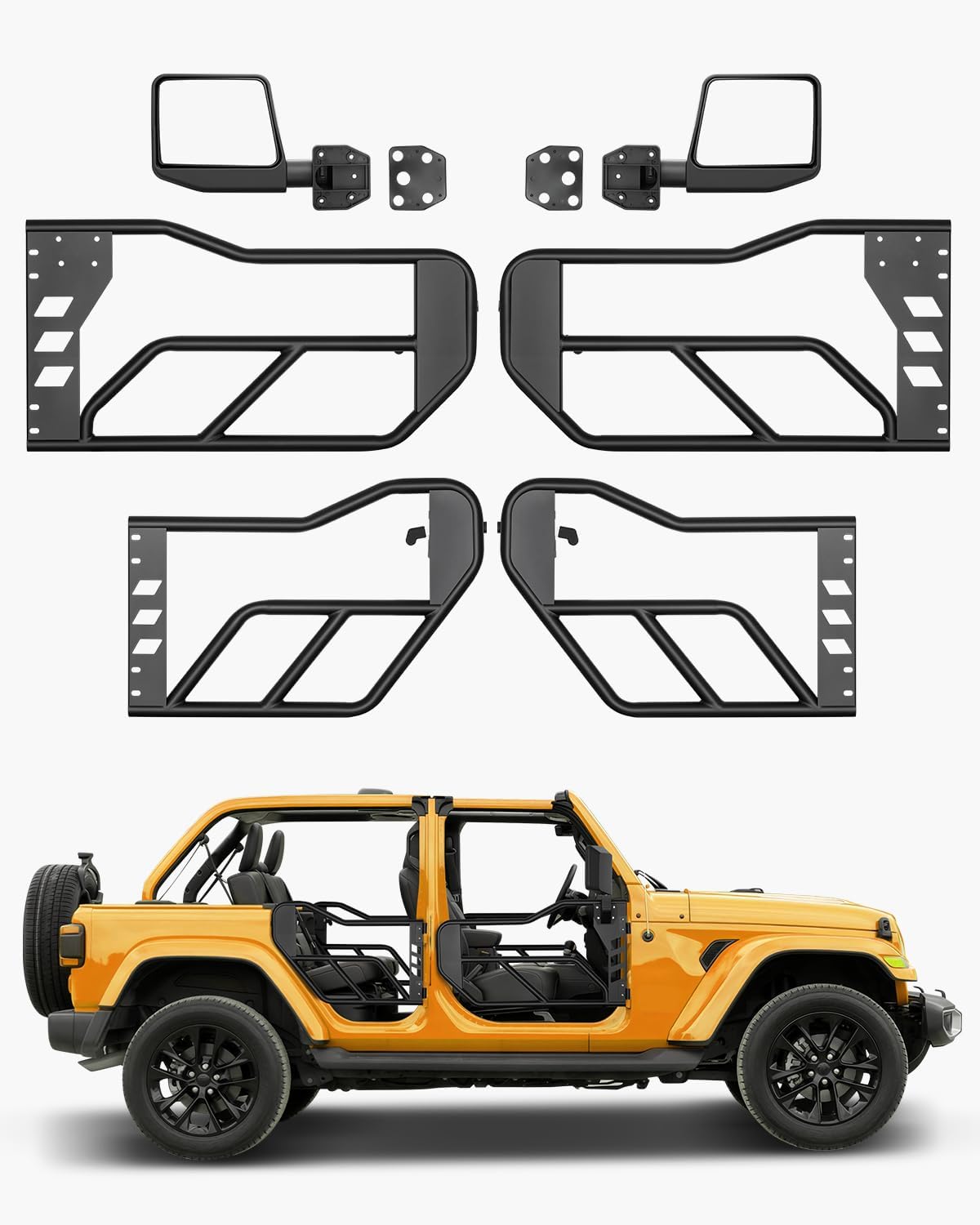
JL/JT owners have the best selection right now. Several manufacturers sell complete four-door tube kits that include DOT-compliant mirrors, so you do not need a separate doors-off mirror setup. JK owners have fewer options but they exist.
Tube doors stay on the Jeep.
No seasonal storage ritual, no hinge bolt rotation, no spring reinstall. The same open-air feel without the off-season hassle. Every link goes to Amazon.
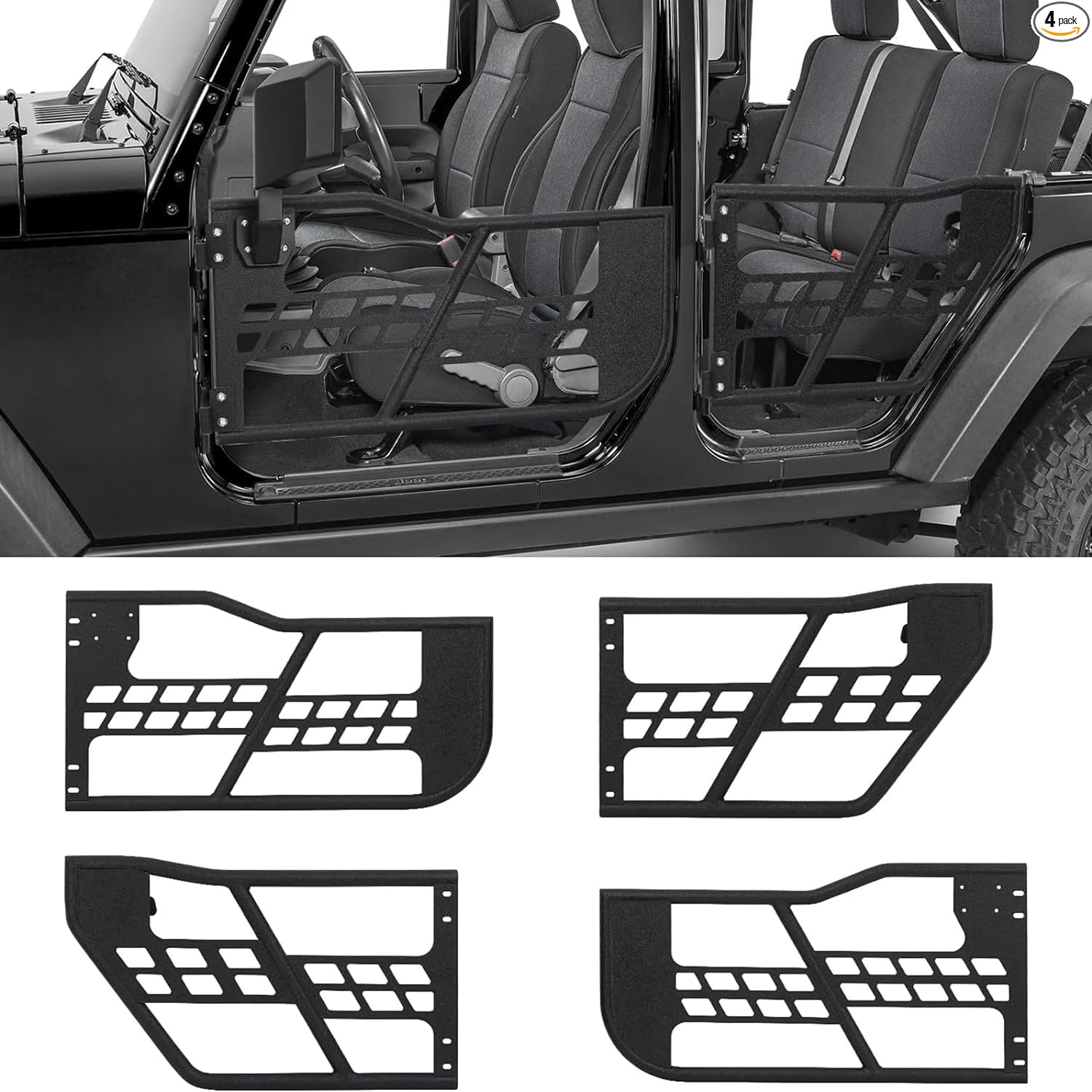
Fat-Tube Half Doors: Set of 4

VEVOR Tubular Trail Doors with DOT Mirrors (Set of 4)
The pre-reinstall checklist
Reinstall day goes smoothly or it does not, and the difference is usually whether you checked a few things while the doors were still in the garage. Run through this before you carry the first door to the Jeep:
- Check hinge pins and striker bolts for rust. Light surface rust on the hinge faces responds to a wire brush and a shot of rust converter. A pitted pin is a harder fix and best dealt with before it is holding a door at 65 mph.
- Inspect the seals. Run your fingers around the weatherstripping perimeter. It should feel pliable. If it is cracking or stiff in spots, apply another round of conditioner and give it a few hours before installing. A cracked seal means water intrusion at highway speed.
- Confirm hardware. Open each door's hardware bag and verify the right bolts are present before you start. Missing hardware on reinstall day is the most preventable version of a bad morning.
- Check the body-side hinge pockets. The sockets on the Jeep body where the hinge pins seat also collect moisture during the season. Give them a wipe and a light application of dry lubricant before the door goes on.
- Torque to spec. Use a torque wrench. The JL/JT hinge bolt spec is 51 ft-lbs per the factory service manual; the JK spec differs, so confirm against your FSM. If you applied anti-seize to the bolt shank, use a torque correction of roughly 0.65-0.75x the dry spec. Under-torqued bolts let the door flex on the striker, which accelerates latch wear over time.
- Check door alignment before you drive. Close each door and look at the gap around the perimeter. The gap should be roughly even at the top, bottom, and latch-side edge without any corner lifting. Then push and pull the glass gently. You should not feel the door flex. Better to find an alignment issue in the driveway than on the highway.
Door storage FAQ.
- What's the best way to store Jeep doors to avoid scratches?
- Hang them vertically from a foam hanger kit or padded wall-mount bracket. The foam-lined hook drops over the hinge-side top edge and keeps bare paint off any hard surface. Never lean doors against a wall or rest them on bare concrete: every vibration in that position creates scuffs, and the weight on the lower edge chips paint at the corners.
- Should I condition Jeep door weatherstripping before storage?
- Yes. A silicone-based rubber conditioner applied before storage keeps the seals pliable through a dry winter. Rubber that sits untreated in a cold, dry garage loses plasticizers and can crack. One application covers a short off-season; re-apply mid-way through a full winter.
- What lubricant should I use on Jeep hinge pins before storage?
- A dry-film PTFE or dry silicone lubricant. Not WD-40, which is a moisture displacer, not a lasting lubricant. It evaporates and leaves a tacky residue that collects more grit than it repels. A dry-film product stays slick through months of storage and does not attract dust.
- Can I store Jeep doors in an unheated garage?
- Yes, with the right prep. Clean them, dry the hinge cavities, condition the seals, and keep them off concrete and away from direct contact with hard surfaces. Cold alone is not the problem; moisture plus grit plus bare metal contact is. An unheated garage with proper prep works fine. Outdoors under a tarp is last resort only.
- Do I need to bag the hardware separately for each door?
- Yes, and label each bag with the door it belongs to. Hinge bolts for JK, JL, and JT are not fully interchangeable across doors, and mixing hardware risks cross-threading during reinstall. One bag per door, attached to the door itself, costs thirty seconds to set up and saves the reinstall day.
- How do foam door hangers work on JK vs. JL doors?
- Most foam hanger kits are sized for either JK or JL/JT doors because the door weight and profile differ. The JK full door is heavier and larger; the JL door is lighter with a narrower profile. Check the listing's fitment notes before buying. A few kits cover both generations, but confirm before ordering.
- Is it worth getting tube doors instead of storing regular doors?
- If you pull doors more than once a season and have adequate storage space, regular storage with a hanger kit works fine. If you find yourself skipping doors-off days because the reinstall hassle is not worth it, or if your storage situation is genuinely bad, tube doors change the math. They stay on the Jeep year-round and eliminate the storage routine entirely.
- How do I check Jeep door alignment after reinstalling?
- Close the door and look at the gap around the perimeter from outside. The gap should be roughly even at the top, bottom, and latch-side edge without any corner lifting or pressing. Then push and pull the glass gently; you should not feel the door flex. If alignment is off, a minor hinge pin adjustment or shim sorts it. Find and fix it in the driveway.
General maintenance guidance for Jeep Wrangler and Gladiator owners. Torque specifications and product compatibility vary by model year and trim, so confirm against your factory service manual before performing vehicle maintenance.
Thirty minutes now.
Clean doors in spring.
The prep takes one evening. The payback is a reinstall day that goes smoothly instead of an hour tracking down hardware and conditioning cracked seals in the driveway.