The garage kills
more batteries than
the trail does.
Pull the doors. Park the rig. Come back three weeks later to a clicking starter and a battery that won't hold a charge. Stock Wranglers and Gladiators draw current around the clock, and a garage-parked Jeep gets zero solar recovery. Here's what actually happens, and what to do about it.
Most owners blame the battery. The battery is usually fine. What killed it is the alarm cycling every hour, the telematics module that never fully sleeps, and two months of sitting in a dark garage with no charge. Fix the charger situation and the battery lasts for years.
How much juice does a parked JL/JT actually pull?
A stock JL Wrangler or JT Gladiator draws roughly 25 to 80 milliamps at rest, depending on trim level. That range matters. A base Sport without the factory alarm sits at the low end. Add the factory security system, the FCA telematics module (UConnect Live), and an aftermarket stereo head unit, and you're easily at 60 to 80mA or more, around the clock.
At 50mA continuous draw, a healthy 700CCA battery (about 70Ah) goes from full charge to too-flat-to-start in roughly three to four weeks. Park for a month and you might get lucky. Park for six weeks without a charger, and you're calling for a jump.
Two things make the JL/JT worse than average:
- The factory alarm doesn't just sit idle. It actively polls sensors in short cycles, and each wake event burns current. These happen more often than most owners expect.
- FCA's telematics module connects to the cellular network even when the ignition is off. Some owners measure 80 to 100mA from this module alone before anything else is counted. Dealers have mixed results disabling it, and doing so voids certain remote services.
A parked JL/JT is not truly off. It's just quiet.
Smart battery tender vs. dumb trickle charger: what actually differs
A dumb trickle charger pushes constant current into the battery regardless of what the battery needs. Fully charged or nearly dead, it pushes the same amps. Left on long enough, a dumb charger overcharges the battery, boils the electrolyte in a conventional flooded cell, and shortens the life of an AGM by heat cycling it repeatedly. Fine for a single afternoon charge; wrong for storage maintenance.
A smart battery tender (also called a maintenance charger or automatic charger) reads battery voltage continuously and adjusts output. It charges at full rate until the battery reaches float voltage, then drops to a low maintenance current that offsets natural self-discharge and the rig's own parasitic draw. You can leave it connected for months without watching it.
The practical difference for a stored Wrangler:
- A smart tender usually costs a little more than a comparable dumb charger.
- A smart tender lets you walk away without worrying about overcharge.
- A smart tender works safely on sealed AGM batteries and on EFB batteries, which many late JL/JT trims use from the factory.
- A dumb trickle charger is correct for an afternoon recovery charge; it's wrong for winter storage maintenance.
If the rig sits for more than two weeks, spend the extra money on the smart charger.
Battery care for the stored rig
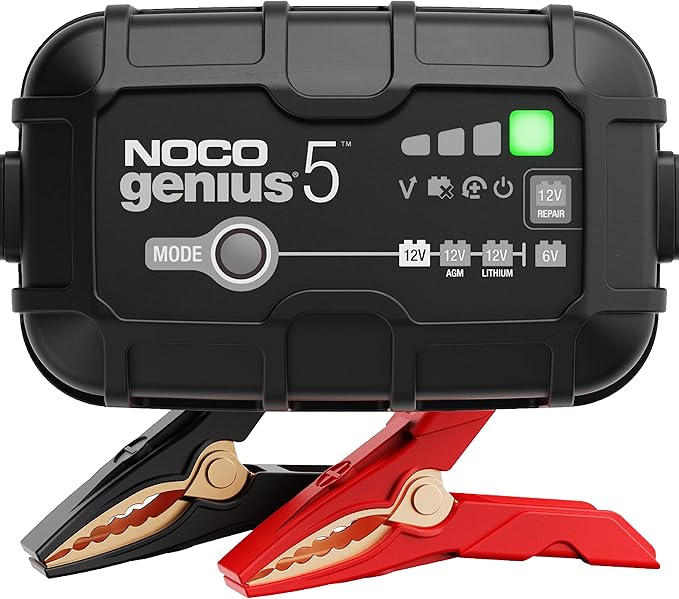
A smart charger to maintain the battery through winter storage and a compressor to handle tires and air-up after. Both go to Amazon.
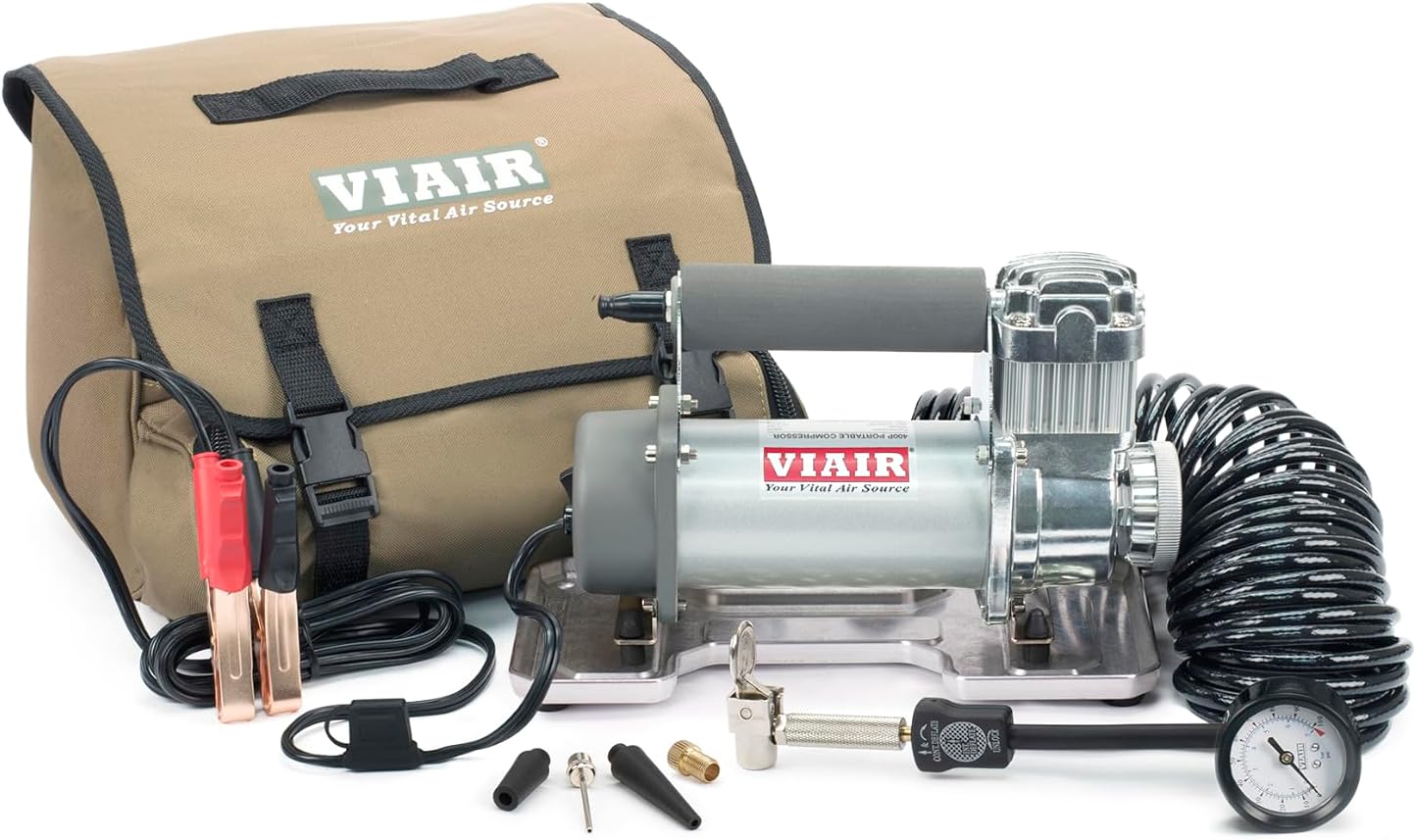

VIAIR 400P 35-Inch Tire Compressor
How to pick a charger for your Wrangler or Gladiator
For most JL/JT owners, a 5-amp smart charger covers the job. You don't need a 10-amp or 15-amp unit for maintenance, and a 1-amp charger takes so long to recover a deeply discharged battery that it's frustrating. Five amps recovers a flat 70Ah battery in about 14 hours then drops to float, which is a sensible overnight cycle.
What to look for before you buy:
- AGM compatibility. Late JL/JT Wranglers and Gladiators often ship with AGM batteries from the factory. An AGM charge mode uses a lower float voltage than a conventional flooded mode. If the charger doesn't list AGM support, it will eventually damage an AGM battery.
- Multi-stage charging. Look for at least bulk, absorption, and float stages. Some smart chargers also include a desulfation mode that can recover a battery that has been sitting deeply discharged for an extended period.
- Reverse-polarity protection. Connect the clamps backward once and you can ruin a charger, or worse. Buy one that handles that mistake safely.
- Weatherproofing. If the charger lives in a condensation-prone garage, an IP65-rated unit handles damp without shorting out.
The NOCO GENIUS5 covers all of those: 5A output, AGM/EFB/lithium compatible, six charge stages including desulfation, spark-proof, reverse-polarity protected, and IP65 rated. It's the charger to use for a JL or JT in storage.
When a jump pack in the cargo area earns its spot
A battery tender handles batteries parked at home. It doesn't help on a trail six miles from the nearest road when a long idle, repeated short cranks, or a winch pull has drained the battery below starting voltage.
A compact lithium jump starter in the cargo area covers that scenario. They weigh under two pounds, fit in a grab bag, and can crank a cold 3.6L Pentastar (JL) or 3.0L EcoDiesel (JT) when a conventional pack would struggle. The V8-equipped JL Rubicon 392 wants a larger-rated pack, so check the peak amps against your engine's CCA requirement before you buy.
They're worth it if you run remote trails where a dead battery means a long wait or an expensive tow. They're optional if your Jeep never leaves cell range and you carry a roadside card.
One thing to know: lithium jump packs self-discharge in storage. Plug yours into a USB port periodically during the off-season, or it'll be flat the one time you actually need it.
Battery disconnect switch: does it earn the install?
A battery disconnect switch, usually mounted in the engine bay or cargo area, breaks the circuit between the battery and the rest of the electrical system. With the switch open, parasitic draw drops to near zero. The alarm can't cycle. The telematics module can't pull current. Nothing drains.
The tradeoffs are real:
- Radio presets, clock, and ECU learned data reset every time you open the disconnect. On a JL, the ECU adapts to your driving style over several hundred miles, and cutting the battery clears that adaptation.
- The factory alarm may briefly trigger after reconnecting on some JL trims. Not a problem, but worth knowing before you reconnect at 6am in a shared garage.
- The install leaves a trace. You're drilling, routing a cable, and adding hardware to the engine bay. If you sell the Jeep later, the disconnect switch either goes with it or you rewire.
For a daily driver or a rig that goes out most weekends, a smart charger is simpler and has none of those tradeoffs. For a dedicated trail Jeep that sits for months at a time, a disconnect switch paired with a smart charger is the right combination. For off-season storage longer than two months where you can't leave a charger connected, the disconnect switch earns its install on its own.

Winter storage checklist for a doors-off rig
This covers the battery side of storage prep. For the full picture on doors, mirrors, tops, and rust prevention, see the winterizing guide.
- Check battery voltage before you park it. A fully charged AGM reads 12.8V at rest. If you're reading 12.4V or lower, charge it fully before hooking up the tender. Starting the tender on a half-dead battery works the charger harder and takes much longer to reach float.
- Connect the smart charger. Hook up the NOCO GENIUS5 or a comparable smart tender to the battery terminals. If the charger has an AGM mode, select it. Leave it connected for the full storage period.
- Check tire pressure. Tires lose roughly 1 PSI per month in cold storage. Set them to the upper end of the door-placard range before storing so they're in spec by spring rather than low.
- Unplug accessories with constant draw. Dashcams on hardwire kits, CB radios, and power banks wired direct to the battery pull current even when the vehicle is off. Unplug or disconnect them before storage, or confirm the charger's output exceeds the combined draw.
- Don't set the parking brake for long-term storage. Brake pads and rotors can bond to each other after months of continuous contact in a damp garage. Leave the vehicle in gear on flat ground or use wheel chocks instead.
- Top off the fuel tank. A full tank reduces condensation in the fuel system. Add a fuel stabilizer if the Jeep sits longer than two months.
Run through this before you cover the Jeep and you'll start spring with a full battery, correct tire pressure, and no surprises on the first crank of the season.
Battery care FAQ.
- How much parasitic draw does a stock JL Wrangler or JT Gladiator have?
- Roughly 25 to 80 milliamps at rest, depending on trim and installed options. A base Sport without the factory alarm sits at the low end. Add the factory security system, FCA's telematics module, and any wired accessories, and 50 to 80mA is typical. At that rate, a healthy 70Ah battery goes flat in three to five weeks without a charger.
- What's the difference between a battery tender and a trickle charger?
- A trickle charger pushes constant current into the battery regardless of charge state. Left on indefinitely, it overcharges and degrades the battery. A smart battery tender monitors voltage and adjusts output, dropping to float maintenance current once the battery is full. You can leave a smart tender connected for months without damage. For storage maintenance, always use the smart type.
- Can I leave a NOCO GENIUS5 connected all winter?
- Yes. Once the battery reaches full charge, the GENIUS5 drops to float mode and holds it there indefinitely. It will not overcharge, and it's IP65 rated, so light condensation in a garage won't hurt it.
- Does going doors-off increase battery drain?
- No, not directly. The doors and their mirrors don't carry battery circuits on a JL/JT. The draw comes from the alarm, telematics module, and anything else wired to the battery, all of which run the same whether the doors are on or off. The bigger factor is how long the Jeep sits between drives.
- How long can I park a Wrangler or Gladiator before the battery goes flat?
- With a healthy battery and stock parasitic draw, expect three to five weeks before the battery drops below reliable starting voltage. High-draw trims with the factory alarm and telematics can go flat faster. A smart battery tender eliminates the question entirely, since it offsets the draw continuously.
- Is a battery disconnect switch worth installing?
- Depends on use. For a daily driver or a rig that runs most weekends, a smart charger is simpler and has no tradeoffs. For a dedicated trail Jeep that sits for months, a disconnect switch and a charger work well together. For off-season storage where you can't leave a charger plugged in, the disconnect switch is worth the install on its own.
- What kind of battery does a stock JL Wrangler have?
- It varies by trim and year. Many JL Wranglers, particularly Sport S and higher, ship with an AGM (absorbed glass mat) battery. Some base models use a conventional flooded battery. The label on the battery itself will say AGM if that's what it is. Any charger or tender you buy should list AGM compatibility if there's any chance your Jeep has one.
- Do I really need a jump pack in the cargo area?
- Not for typical use. If your Jeep never leaves cell range and you carry roadside assistance, you can skip it. If you run remote trails where a tow would take hours, a compact lithium jump starter is cheap insurance. They weigh about two pounds and work without a second vehicle.
General guidance for Jeep Wrangler and Gladiator owners, not professional advice. Battery, electrical, and fuel system specs vary by model year and trim. Confirm specs against your owner's manual before making changes.
Tender on.
Keys in.
A smart charger costs twenty dollars and saves a battery that costs two hundred. Connect it once, leave it all winter, and the first day of doors-off season starts with a full charge instead of a jump-start call.